




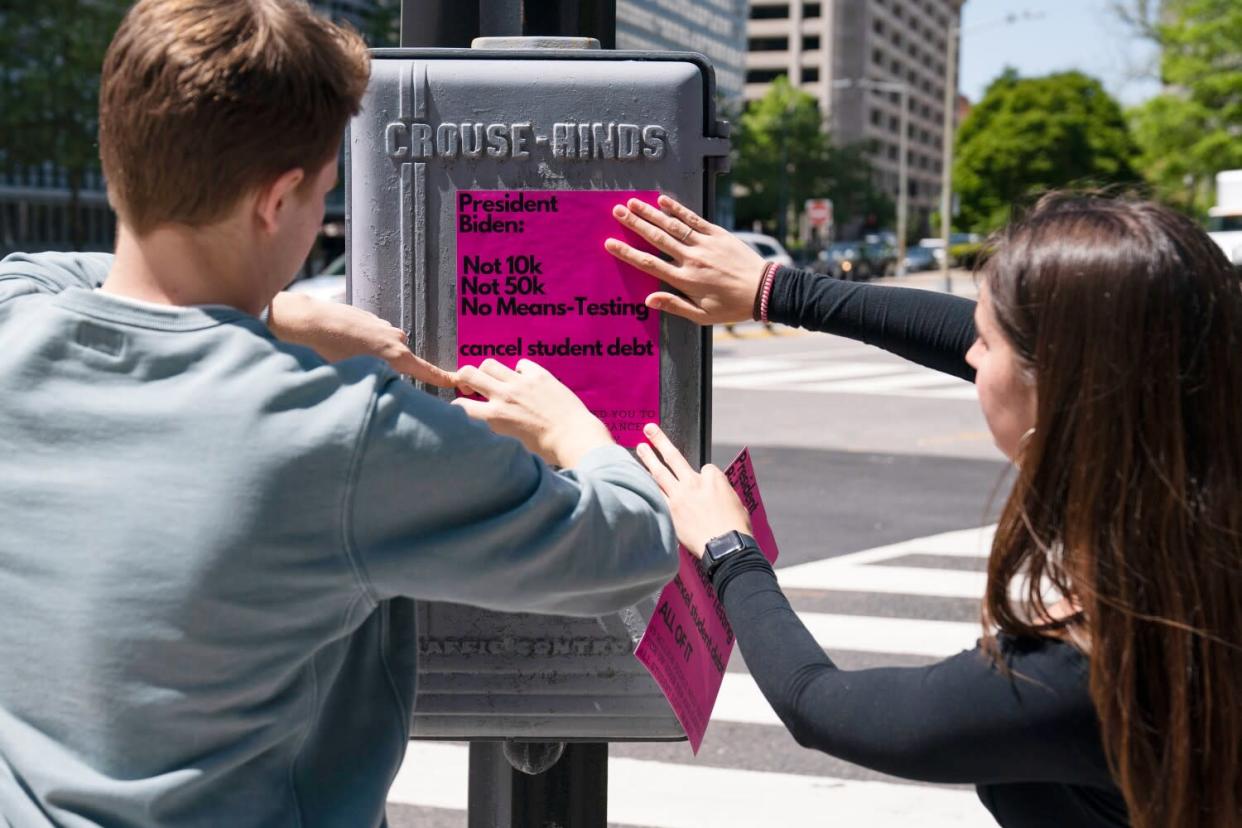
The Biden administration has been considering a plan to cancel at least $10,000 of federal student-loan debt. President Biden promised something of the sort during the 2020 presidential campaign. And with about 45 million current and former students carrying $1.76 trillion in debt, some sort of debt forgiveness is appealing both as policy and as politics.
But what kind of debt forgiveness, and how much for whom?
What makes that a hard question is that there is not one student debt problem; there are dozens. They range from mega-loans for Harvard Business School degrees that yield Wall Street jobs with mega-salaries to much smaller amounts borrowed to pay for vocational training that proved almost worthless, if not an outright scam.
Some advocates of student loan forgiveness argue that the overall economy would also get a boost by enabling debtors to become bigger consumers.
Most economists say the overall impact of reducing student debt would be modest, but others say forgiveness would enable the beneficiaries to move forward with their lives instead of being dragged down by burdens that — in many cases — are all but impossible to bear.
What’s the plan being considered?
Since COVID-19 descended on the U.S. in March 2020, the White House, first under President Trump and then Biden, has put on hold the repayment requirement and interest accrued on federal student loans, providing relief to some 37 million people.
About 80% of all outstanding student loan debt, or about $1.38 trillion, was borrowed directly from the government, says Ben Kaufman, research director at Student Borrower Protection Center, an advocacy group. The rest came from banks and other private lenders, some of which are covered by federal guarantees.
The payment pause was among various emergency steps taken in response to the pandemic. But this moratorium, uniquely, has been extended six times, now through Aug. 31.
Student borrowing for college, trade school and graduate work has skyrocketed in the last two decades, in large part due to soaring tuitions. Americans are now carrying more than triple the amount of student debt in 2006, when the Federal Reserve began tracking the data. That’s more than either the nation’s total borrowing on credit cards or for auto loans.
On average, a borrower owes about $39,000 in education debt, but the median amount is about half that.
While another extension is possible, even likely, the Biden administration is said to be weighing a plan to cancel around $10,000 for people making less than $125,000 a year, although reports indicate that setting an income cutoff may prove hard to get through Congress.
Who would most benefit from partial forgiveness?
Canceling $10,000 would eliminate the student debt for about a third of all borrowers, according to data from the College Board. Another one-fifth would stand to have their student debt balance cut by at least half.
But Biden doesn’t have authority to cancel private student debt. Millions of students also borrowed under the Family Federal Education Loan, and most of that debt is owned by commercial banks.
All told, the New York Fed says 10 million people with student loans did not get relief from the payment pause, and most of them would be left out of a forgiveness plan because their loans came from private lenders and legally the government cannot just erase them.
Among others who won’t benefit are those who’ve already paid off their student loans. And then there’s the question of fairness to the even larger segment of the population who never had any college debt because they never went beyond high school.
“Many of the people who are struggling the most [in the economy as a whole] are people who didn’t go to college at all,” said Sandy Baum, an economist at the Urban Institute.
Wouldn’t canceling student debt benefit everyone because it would boost the economy?
On the surface, it would seem that lifting the weight of $10,000 for tens of millions of adults in their prime spending years would give a big boost to the economy.
In one recent study by Bankrate.com, about 7 out of 10 Gen Z’ers (ages 18 to 25) and millennials (26 to 41) who took out loans to finance higher education said they had delayed a major financial decision, such as having children or buying a car, as a result of that debt.
But while forgiving debt would certainly free up some cash to spend, economists widely agree that the impact to the economy would be small.
The U.S. economy is huge — $25 trillion in current dollars — and canceling $10,000 per student would reduce annual loan payments by only about $18 billion a year, according to the Committee for a Responsible Federal Budget. Most student loans are paid back over 10 to 30 years.
And some borrowers will want to use the monthly savings to draw down other debts, or just sock away the cash for emergencies.
“In the near term, it’s a small positive,” said Mark Zandi, chief economist at Moody’s Analytics. Longer-term, it’s more complicated, he said. You’re shifting the burden from borrowers to other taxpayers, Zandi said, and it raises questions about fairness and moral hazards, like the temptation to borrow more because you think you’ll never have to pay it back.
Of course, the government funds many programs that may or may not benefit everyone economically — corporate tax breaks and farm aid and price supports, among many others.
What about the impact on homeownership?
It’s frequently been argued that the mountain of student debt has hurt the housing market. The National Assn. of Realtors, in a 2017 study, reported that the financial burden was such that younger borrowers delayed home-buying by several years.
To be sure, without student loans to pay back, people would have more money to save for a down payment. How much overall debt one has relative to income also is a factor in qualifying for a mortgage. And those who have defaulted on student loans — about 1 in 6 borrowers — will see a hit to their credit scores.
Still, experts say it’s hard to prove there’s a causal relationship between home-buying and people who have student debt versus those without it. And other research suggests that over time homeownership rates of college graduates with and without student debt are not significantly different.
But it made a difference to Grace Poulos, 24, who earned a bachelor’s degree in international politics from the University of Tampa in May 2020. She borrowed $26,000 in federal loans and figures she would have been repaying about $250 a month had it not been for the moratorium.
After college, Poulos moved back home in the Chicago area. Living rent-free with her family, she worked part-time and managed to save about $10,000. Last summer, she got a job as a data and policy analyst for a nonprofit in Tulsa, Okla., with a salary of $40,000. And in July, she put down $6,000, or 3%, on a $150,000 townhouse in downtown Tulsa.
Poulos said she would have qualified for a mortgage even if she had paying back her student loan, but she’s not sure she’d have enough monthly income to meet her payments.
Currently her monthly expenses include about $880 for housing and $200 for a car loan. After paying for groceries, utilities and other bills, Poulos says, she may have $100 to $150 left over every month.
“I wouldn’t have any wiggle room for student loans,” she said.
What if the government forgave $50,000, as some have urged?
Canceling up to $50,000 would eliminate all student debt for more than 80% of borrowers. Experts estimate that this plan would cost the government about $1 trillion.
Despite the larger amount, the economic bang for buck wouldn’t be any bigger. In fact, the so-called economic multiplier effect would be even less than it would be for canceling $10,000, experts say.
One reason is that a lot more of the benefits would go to those who are better off financially and thus would be less likely to spend the extra cash.
That’s the problem with blanket loan forgiveness, analysts say. It’s poorly targeted and regressive.
This may seem odd given that proponents for higher amounts of forgiveness argue that’s needed to help disadvantaged students, those who began with less family wealth and so had to borrow more for schooling. Black college graduates owe about $25,000 more in student loan debt than white counterparts.
But Adam Looney, a University of Utah professor and former Treasury Department official, says universal loan forgiveness would benefit many whites who have “disproportionately higher income, from more affluent backgrounds, and are better educated.”
As social policy, larger forgiveness plans would not narrow the racial wealth gap, and Looney believes it could actually make such inequities worse in some ways.
He points out that students in high-earning fields such as dentistry, medicine and law rack up some of the biggest debt. Yet Black people are underrepresented in these fields.
Then is there a better way to address the problem?
To some, it may look like there are just two paths: either provide across-the-board loan forgiveness of some amount, or let millions of borrowers resume making normal payments and face “significant economic hardship,” as Biden stated in extending the repayment pause through August.
But it doesn’t have to be this way. Under present law, borrowers who are on the hook for federal student loans can sign up for a repayment schedule that’s based on their current incomes, not the amount of debt.
That would ensure that borrowers would pay no more than, say, 10% of their discretionary income on student loans. If they become unemployed and have zero income, their monthly loan payment would drop to zero.
Income-driven repayment, as it’s called, has been in existence for some years, but just 32% of federal direct loan borrowers had enrolled in it as of last year, according to the College Board.
Some attribute the limited participation to paperwork and other hoops that borrowers must go through.
And the program does not apply to those who borrowed from private lenders, even though many of those loans are backed by federal guarantees.
Economists like the Urban Institute’s Baum think repayment schedules should automatically be set on the basis of income. “There are so many problems with the student loan repayment system; they should fix it,” she said.
While not an answer to those already saddled with a lot of student debt, Looney says that doubling the needs-based Pell Grants would better target low-income, nonwhite students, supporting their college education and at the same time reducing the amounts they would have to borrow.
That might appeal to advocates of greater social fairness, but it would do little or nothing for middle-class and upper-middle class borrowers or their families. And they make up a large share of student borrowers and the overwhelming majority of voters.
This story originally appeared in Los Angeles Times.